Get the kit · $19.90
Container Garden Starter Kit

Grow edible plants on a balcony, starting from zero.

A printable kit for people who have never grown food, or who tried once and watched it die. Twelve forgiving plants, a week-by-week plan, and a planting calendar built from your own ZIP code.

  • No yard needed: everything grows in pots
  • A first harvest in about 60 days is typical for the quick plants, such as radishes, lettuce and basil
  • A three-container starter garden for under $50 in supplies, at the example prices in the kit

Instant PDF download · One-time payment · 14-day money-back guarantee

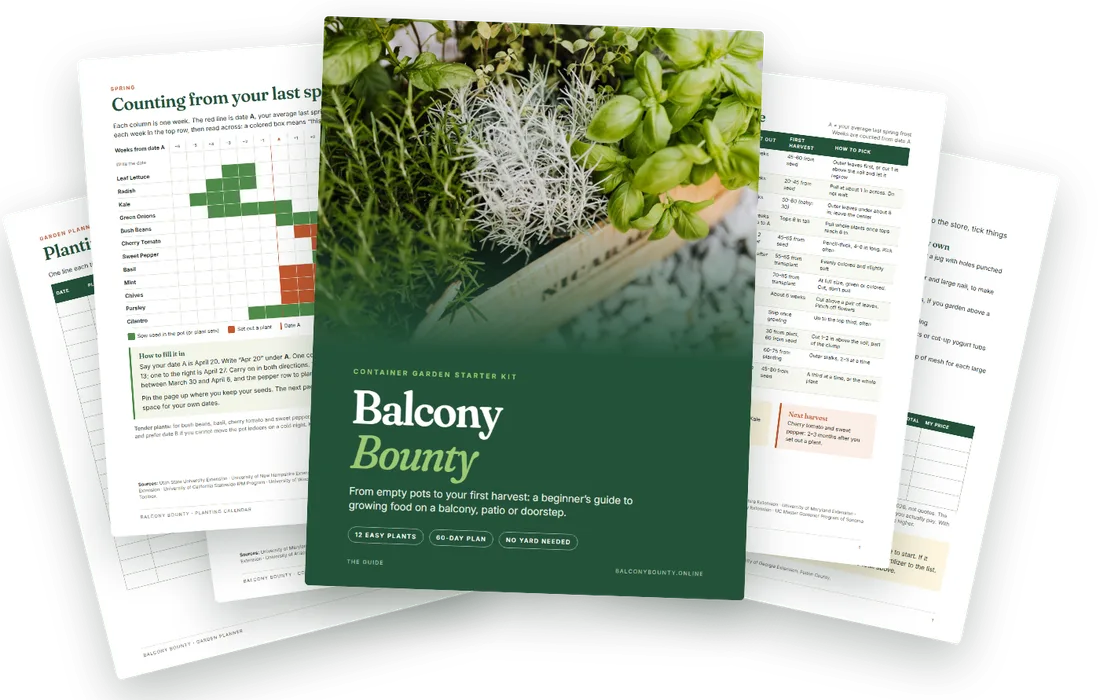
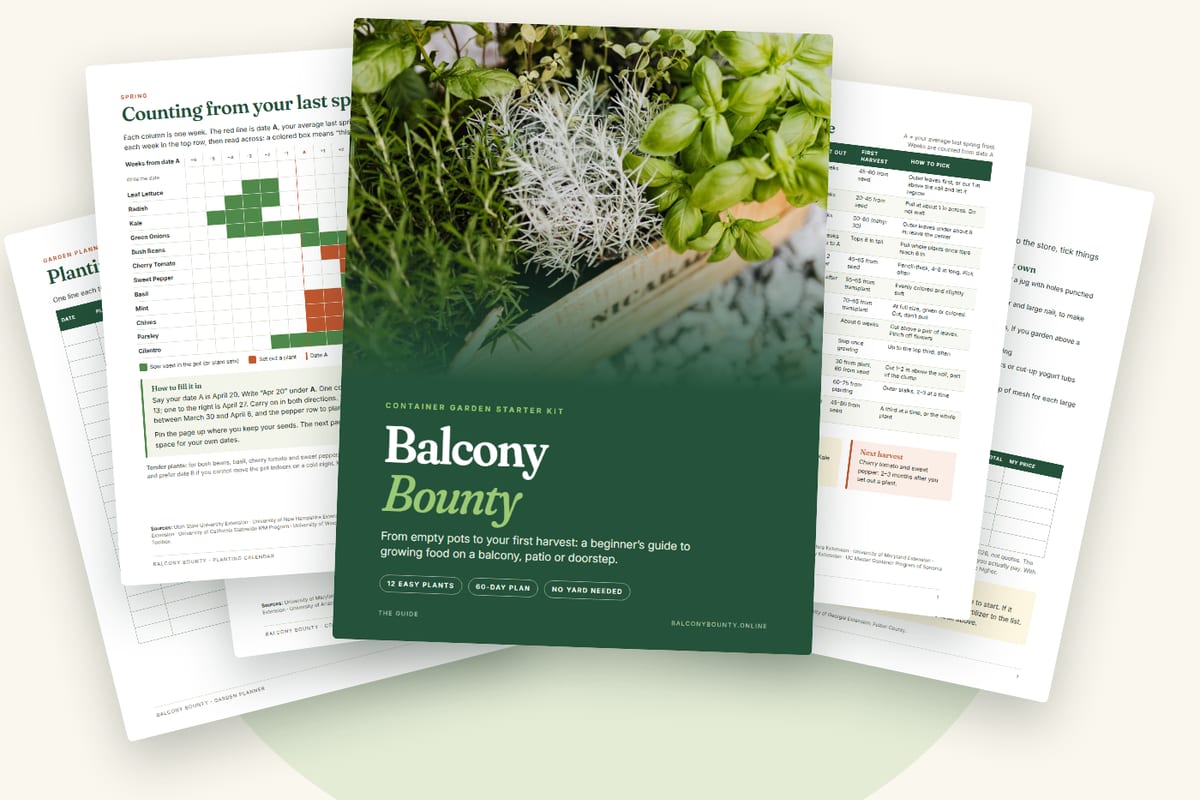
The six Balcony Bounty PDFs fanned out: the guide cover, the planting calendar, the quick reference card, the shopping list, the companion chart and the garden planner
  • 6 printable PDFs
  • 83 pages
  • 12 beginner plants
  • 134 university & NOAA sources
  • 33,000+ ZIP codes with frost dates
Day 1 is the day your first seeds go in.
How it works

Three decisions, in the right order.

  1. Count your sun

    A one-day check tells you which of the 12 plants your balcony can actually grow, before you buy a single seed.

  2. Find your two dates

    Type your ZIP code. The calendar turns your local frost dates into planting windows for every plant, spring and fall.

  3. Follow the plan

    A short checklist for each week of the first 60 days: what to sow, what you should be seeing, and when to start picking.

Why first gardens fail

It usually isn’t a “brown thumb”. It’s one of these five.

They are ordinary, they are fixable, and each one has its own page in the guide.

1

Not enough sun for that plant

Lettuce is content with 3 to 5 hours of direct sun. A tomato wants 6 to 8. The kit starts with a sun check, so you choose plants your space can actually grow.

2

A pot that can’t drain

No holes, or a layer of gravel that was supposed to help and doesn’t. Roots sitting in water rot.

3

Dirt from the ground

Garden soil compacts in a container until air and water stop moving. The guide tells you what to look for on the bag instead.

4

The right plant on the wrong date

Basil is damaged at 50°F. Lettuce turns bitter in summer heat. Planting dates depend on your local frost dates, not on your hardiness zone.

5

Watering by the calendar

A pot can need water twice on a hot, windy day and none for several days in a cool spell. A ten-second finger test beats any schedule.

What the kit does about it

It puts those five decisions in order, gives you a short checklist for each week, and tells you plainly what to expect and when.

See what’s inside
What’s inside

6 PDFs, 83 pages, one job.

Everything prints on ordinary letter paper. Open it on your phone in the garden aisle, or pin the pages up by the door.

57 pages

The Guide

Eleven short chapters from choosing a spot to your first harvest: sun, containers, potting mix, watering, when to plant, the 12 plants one page each, a week-by-week plan, harvesting, a symptom finder, herbs on a windowsill and a glossary.

7 pages

Planting Calendar

Planting windows counted from your own frost dates, for spring and fall. The online builder fills the dates in from your ZIP code.

2 pages

Quick Reference Card

The 12 plants and the rules that matter most, on two pages to print back to back and keep by the door.

4 pages

Shopping List

A three-container starter garden, a budget worksheet with example prices, and what to leave on the shelf.

5 pages

Companion Chart

What can share a pot and what cannot, with what is supported kept apart from what is only tradition.

8 pages

Garden Planner

Sun check, pot map, planting log, weekly check, harvest log, seed inventory and season review.

Look inside

These are pictures of the real pages. Tap one to read it.

The 12 plants

Chosen because they forgive beginners.

Each one has its own page in the guide. Tap a plant to see a few of its facts.

Leaf Lettuce

The quickest way to eat something you grew.

First 60 daysCool-season
Container
At least 6–8 in deep. Minimum 2 quarts; a 1–3 gallon pot or a window box is easier to keep moist. Thin to 4–6 in apart.
Sun
3–5 hours of direct sun is enough. Full sun is fine in cool spring and fall weather.
First harvest
45–60 days from seed. You can start picking outer leaves when plants are 5–6 in tall.
When
Sow 2–3 weeks before your last spring frost. Sow again 8–12 weeks before your first fall frost.
Most common mistake: Sowing too late in spring. Long days and summer heat make lettuce send up a seed stalk (bolting) and turn bitter. Once that starts it does not reverse: pull the plant and sow again when it cools down.
About those 60 days

Some plants feed you in weeks. Others take a season.

The kit is clear about which is which. Here is every plant’s typical time to a first harvest, as published by university Extension services.

Plant
030609012060 days
Radish
20–45 · from seed
Chives
30–60 · 30 from a plant, 60 from seed
Basil
38–46 · about 6 weeks after planting
Leaf Lettuce
45–60 · from seed; outer leaves sooner
Cilantro
45–80 · from seed; quick varieties 28–40
Bush Beans
45–65 · from seed
Green Onions
50+ · from seed, 50 days or more; sooner from sets
Kale
50–60 · baby leaves from about 30
Parsley
60–75 · after planting
Cherry Tomato
55–65 · after setting out a plant; 90–130 from seed
Sweet Pepper
70–85 · after setting out a plant
Inside about 60 daysAbout two monthsNext harvest: not part of the 60 days

Typical ranges in good conditions: the right season and enough sun. Weather, shade and variety change them, and they are not a guarantee. Mint is left out: bought as a plant, it can be snipped as soon as it is growing strongly.

Try it

See your planting season for your ZIP code.

Planting dates hang on two frost dates most beginners have never heard of. This is the lookup the kit’s calendar is built on.

Freeze dates: NOAA U.S. Climate Normals 1991–2020, nearest station with freeze records. ZIP locations: U.S. Census Bureau. Nothing you type here is sent to us.

A real page from the guide

One page per plant. No filler.

This is the leaf lettuce page, exactly as it is in the PDF.

  • Six facts at the top: container, sun, water, first harvest, how to start, when to plant
  • How to plant it, keep it going and harvest it so it keeps producing
  • The mistake beginners make most with that plant
  • The sources for the page, named at the bottom
Where the information comes from

No guru. Sources.

The growing advice was compiled from 134 publications of U.S. university Cooperative Extension services, the public, research-based gardening programs of state universities. Frost dates come from NOAA’s climate normals.

  • Every page names its sources; the full list with web addresses is at the back
  • Where universities disagree, the kit shows the range instead of inventing one answer
  • It says “we could not find a source for this” where that is the case

Some of the publishers cited

  • University of Maryland Extension
  • University of Illinois Extension
  • Utah State University Extension
  • Iowa State University Extension
  • Penn State Extension
  • University of Wisconsin–Madison Extension
  • NC State Extension
  • University of California Statewide IPM Program
  • Clemson Cooperative Extension
  • Oregon State University Extension
  • University of New Hampshire Extension
  • NOAA National Centers for Environmental Information
  • NOAA Climate.gov
  • USDA Agricultural Research Service

Balcony Bounty is an independent publication of general gardening information. It is not affiliated with, reviewed by or endorsed by NOAA, the USDA or any university, and it is not professional advice for your particular home.

Doing it yourself, or with the kit

The information is out there. The kit puts it in order.

On your ownWith Balcony Bounty
Planting datesFind your frost dates, then count weeks for each plantType your ZIP code; the calendar does the counting
What fits your spaceTrial and errorA one-day sun check matched to the 12 plants
How to grow each plantScattered across dozens of university pagesOne page per plant, same layout, sources named
What to do this weekGuessworkA week-by-week checklist for the first 60 days
When something looks wrongSearching symptomsA symptom finder that sends you to the right page
Keeping trackMemoryA printable planner and a quick reference card

This kit is for you if

  • You have a balcony, patio, deck or doorstep with at least a few hours of direct sun
  • You are starting from zero, or starting again
  • You want a short list of what to do each week, not a 300-page book
  • You like to print things and tick them off

It is not for you if

  • You want a video course. This is PDF only
  • You already garden and want advanced techniques
  • Your only space gets no direct sun at all
  • You are looking for a promise of a harvest by a fixed date. Nobody honest can give you one
Get the kit

Balcony Bounty: Container Garden Starter Kit

The six PDFs of the kit
$19.90one-time payment, in U.S. dollars
  • The Guide, 57 pages: 12 plants, a week-by-week plan, a symptom finder and herbs on a windowsill
  • Planting Calendar, 7 pages, plus the online builder for your ZIP code
  • Quick Reference Card, 2 pages
  • Shopping List, 4 pages, with a budget worksheet
  • Companion Planting Chart, 5 pages
  • Garden Planner, 8 printable pages
  • Instant download. Yours to keep and reprint every season
Get the kit · $19.90

No subscription. No automatic charges. Sales tax may apply where you live.

14-day money-back guarantee. If the kit is not what you expected, email us within 14 days of your purchase and we refund the full amount. You don’t need to give a reason. Details in the Refund Policy.

Questions

Before you buy

Is this a physical product?

No. Balcony Bounty is a set of 6 PDF files (83 pages in total) that you download right after payment and can print at home. Pots, potting mix, seeds and plants are not included.

I don’t have a yard. Will this work?

That is who it is written for. Everything in the kit grows in containers on a balcony, patio, deck, stoop or doorstep. What you do need is direct sun: at least 3 to 5 hours for salad leaves and most herbs, and 6 or more for tomatoes, peppers and beans. The first thing the guide has you do is count your sun, before you spend anything.

How soon will I harvest something?

It depends on the plant, the season and your weather, so nobody can promise you a date. As a guide, university Extension services give 20 to 45 days from seed for radishes, 45 to 60 for leaf lettuce and about 6 weeks for basil, in good growing conditions. Cherry tomatoes and peppers take much longer and are not part of the 60-day plan.

How much will the supplies cost?

The Shopping List builds a three-container starter garden. With the example prices we saw on large U.S. retailers’ websites in October 2026, that basket came to $44.28: three food-grade buckets, a bag of potting mix, four seed packets and a bag of onion sets. Prices vary by store, region and season, and the list has a column for what you actually pay.

Will the planting calendar work where I live?

The calendar is built on frost dates from NOAA weather stations, matched to more than 33,000 U.S. ZIP codes. In places that almost never freeze, such as southern Florida, coastal southern California and Hawaii, a frost-based calendar does not apply, and the kit tells you so and points you to your state Extension service instead.

It’s not spring. Is there any point buying now?

Yes, if you want to be ready. Cool-season plants are sown weeks before the last spring frost, earlier than most beginners expect, and again in late summer for fall. Buying ahead gives you time to check your sun, find your dates and collect containers. And the guide has a chapter on keeping basil, chives, parsley, mint and cilantro going on a windowsill through the cold months.

I have killed every plant I have owned. Is this for me?

It is written for exactly that reader, and it is honest about what goes wrong: too little sun for the plant chosen, pots with no drainage, garden soil instead of potting mix, planting warm-weather plants while it is cold, and watering by the calendar. The guide has a page on each, and a symptom finder for when something looks off. It cannot guarantee your plants will live. It can make the usual mistakes much harder to make.

Who wrote it? Is it expert advice?

The kit was compiled from 134 publications of U.S. university Cooperative Extension services and from NOAA climate data, and it names its sources at the bottom of every page, with web addresses at the back. It is a beginner’s guide of general information, not professional advice for your particular home, and the universities and agencies it cites did not review or endorse it.

What if it isn’t what I expected?

Email us within 14 days of your purchase and we refund the full amount. You don’t need to give a reason.

How do I get the files?

As soon as your payment is approved you see a download link, and the same link is emailed to the address you used at checkout. The files open on any phone, tablet or computer and print on ordinary letter paper.
Your first harvest starts with counting the sun.

Six printable files, one short checklist a week, and planting dates for your own ZIP code.

Get the kit · $19.90

Instant PDF download · One-time payment · 14-day money-back guarantee

$19.906 PDFs · 14-day guarantee
Get the kit